Succes Story: How This Couple Launched Their AirBnB Business.
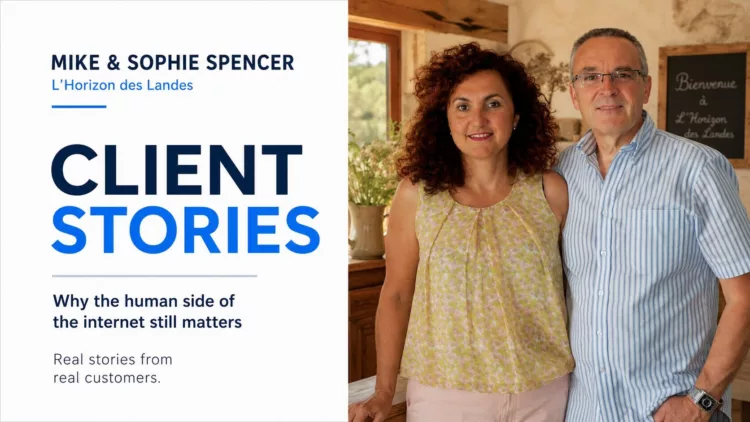
From CompuServe and hand-coded HTML to Airbnb and AI, entrepreneur Mike Spencer explains why reliable domains and human support still matter.
The internet has changed beyond recognition. The need for good customer service has not.
Mike Spencer has been online since the days of CompuServe and Prestel, when connecting to the internet meant navigating DOS-based services and building a website could involve an entire night of HTML. Today, the technology surrounding his family-run business in southwest France looks very different. Accommodation bookings arrive through global platforms. English courses are promoted through social media. Domains, hosting and email help several parts of the business maintain their own digital presence.
But after watching the internet transform over several decades, Mike believes that in this fast-paced digital environment, one thing has become more valuable than ever: the ability to speak face-to-face and connect with real people.
That principle is central to why Mike has stayed with EuroDNS. It also reflects the philosophy behind L’Horizon des Landes, the guest house he runs with his wife, Sophie: a rural place built around personal attention, warm hospitality and genuine human contact.
Mike Spencer at a glance
- Location: Doazit, Landes, Nouvelle-Aquitaine, France
- Business: L’Horizon des Landes
- Activities: Guest rooms and studios, table d’hôtes, English training, seminar-room hire and campervan pitches
- Business partner: Sophie Spencer
- Online channels: Business websites, Airbnb, Booking.com, Facebook and Instagram
- EuroDNS customer: More than ten years
Website:horizondeslandes.fr
From CompuServe to a family business online
Mike’s relationship with the internet began long before websites became simple to build or smartphones put the web in everyone’s pocket.
“I’ve been using the internet since the days of CompuServe, Prestel and these other services that were basically DOS-based.”
In those early years, creating something online demanded patience. Mike had to manually code pages in HTML. A single syntax error could mean that hours of work could disappear in a single keystroke. The tools are easier now. A local business can reach customers around the world, change a page without writing code and connect its availability to multiple booking services. Yet the modern internet has also accumulated new layers: domains, DNS, SSL certificates, hosting panels, email and security settings.
For Mike, progress has made running a business online more accessible but not always more approachable.
A local business with a global front door
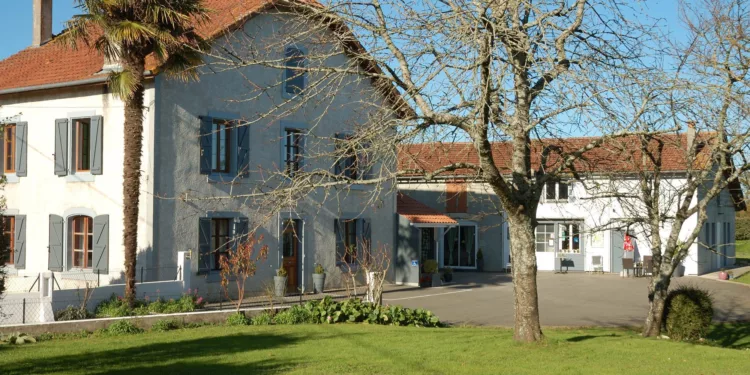
L’Horizon des Landes began in 2010, when Mike and Sophie acquired an old farmhouse in Doazit, in the Chalosse area of the Landes. After extensive renovations, they opened three guest rooms in 2012 and added a fourth in 2017. What began as a guest house has steadily grown into a much broader rural tourism business. Today, guests can choose from four individually named rooms and a 30 m² studio with its own entrance and kitchen. Evening meals are available by reservation through the property’s table d’hôtes.
Beyond accommodation, Mike and Sophie offer English training, an equipped 40 m² seminar room and a natural area for up to six campervans. A covered bodéga provides space for barbecues, picnics and relaxation, while dwarf goats, ducks and chickens bring a small farm to the property’s 7,000 m² grounds.
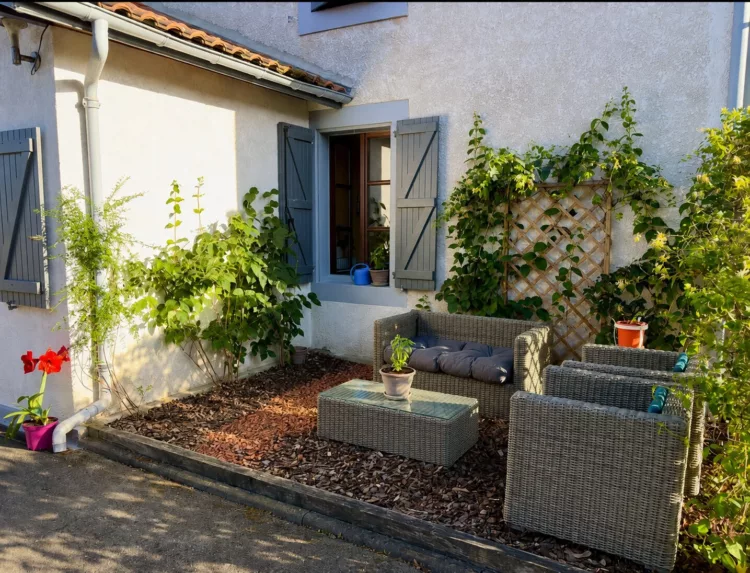
It is an unmistakably local business, rooted in a renovated farmhouse and a quiet rural setting. But the people searching for it could be anywhere.
To reach them, the business uses a channel-management platform that brings together reservations from services such as Booking.com and Airbnb.
The day of the interview also brought a small milestone: their first Airbnb booking through the new setup.
Mike is realistic about what an independent website can achieve beside global marketplaces. He is equally sceptical of anyone promising to put every small company at number one on Google.
“You need a presence on the internet. The main thing is to keep it active, keep the content changing and put news on.”
For the English courses and the wider business, Facebook and Instagram help the couple tell their story and remain visible. Their own website provides the stable digital home behind that activity, with multilingual information, live availability and direct online booking.
Why Mike chose EuroDNS
Mike previously managed his domains through a UK provider. Living and operating in France created practical complications, including VAT treatment and difficulties registering French and international domain names.
That search brought him to EuroDNS.
“They have a massive selection of domains to choose from at reasonable prices, and it’s very fast and efficient. Every domain I buy now is through EuroDNS.”
Domains were the starting point. Over time, hosting and email became part of the relationship too. Mike valued having email included with his hosting and increasingly wanted to consolidate his online services with a provider based in Europe.
The .FR domain. and .EU domain are a natural fit for L’Horizon des Landes. Although the guest house is firmly rooted in southwest France, its customers cross national borders. The website serves visitors in multiple languages, and the .EU extension gives that multinational audience a clear signal that the business is European rather than limited to one domestic market.
Mike is now gradually moving his remaining websites away from other providers and bringing more of the business under EuroDNS. For L’Horizon des Landes, that digital foundation supports an international audience while connecting visitors to live availability and secure booking.
When self-service is not enough
Yet the move has not been completely frictionless and Mike does not pretend otherwise. He initially found Plesk control panel more complicated than the website-building tools he had used before. Installing an SSL certificate also became a source of frustration. With numerous settings and unfamiliar terminology, it can be overwhelming for a busy business owner trying to manage it alone.
The difference was that Mike could reach someone who understood the issue.
A EuroDNS support colleague helped configure the SSL certificate and get the website working securely.
“I like the fact that I’m not dealing with a robot. Sometimes I need to ask a person. It may be a subtle question, or I may be pulling my hair out, and I need to talk to a person.”
Mike is not opposed to AI. He uses it and recognises where automation can help: his objection is to using it as a barrier when somebody needs judgement, reassurance or a conversation that does not fit a scripted answer.
The part of the old internet worth keeping
Asked what he misses about the internet’s earlier days, Mike does not romanticise the technology. Hand-coding websites was slow, unforgiving work. Modern tools are unquestionably more capable.
What he misses is the pace and the human contact that can disappear when every interaction becomes automated.
“I think everything’s too quick. And I like to speak to people. I’m one of these old-fashioned people—I’d rather wait in a queue and talk to a person.”
It is a philosophy that runs through his view of business. Customers want to see the people behind a company. A short video, a familiar face or an accessible support team can communicate something that another automated workflow cannot: someone is present, accountable and ready to help.
For a domain and hosting provider, that matters most when the technology stops feeling simple.
Small businesses need people behind the platform
Mike’s experience points to a wider reality. Small and medium-sized businesses depend on the internet, but most do not employ specialists for every technical task.
“There are an awful lot of people out there like me: small and medium-sized enterprises that rely on the support you can offer. They haven’t got tech experts who do all this sort of thing.”
A domain may be one product in an account, but behind it could be a family business, a newly listed room, a course waiting for its next participants or years of work spent building a local reputation.
Reliable administration matters too. Mike describes EuroDNS invoicing as “first class” because it keeps him informed, including when an invoice has a zero balance. Small details like that reduce uncertainty and make a technical service easier to trust.
For Mike, multilingual support is another practical advantage. He speaks French, but technical conversations are easier in English. Being able to communicate in the language he is most comfortable using makes resolving problems less intimidating.
What comes next
With the booking infrastructure now in place, Mike and Sophie want to attract more guests and connect with additional organisations. They are also strengthening the business’s presence on Instagram and want to publish more stories through their websites.
Mike is interested in a blog not because he expects it to produce instant search rankings, but because stories remain useful. The transformation of an old farmhouse, the growth of the guest house and everyday life around its rooms, bodéga and mini-farm offer something a booking listing alone cannot: a sense of the people and place behind the reservation.
It is a fitting ambition for someone who believes the internet works best when technology creates more connection, not less.
Technology changes. Trust remains personal.
From CompuServe and hand-coded HTML to booking channels, social media and AI, Mike has experienced several generations of the internet. The tools have changed dramatically. The underlying need has not.
Small businesses need a reliable place to build their presence. They need services that work without demanding a technical department. And when something becomes complicated, they need to know there is a person behind the platform.
That is why Mike continues to recommend EuroDNS and share its work online.
“I don’t expect anything in return. I’m happy to do it because I want to support the company.”
The $10 Domain Dispute: When MikeRoweSoft Met Microsoft