40 applications, 80 proposed domain extensions: ShortDot's next chapter

We caught up with Leroy Dsa, Head of Global Sales at ShortDot, to talk about what makes a good extension, the names he keeps coming back to and why short names might have particular appeal in Europe.
Three letters. Four at most. And plenty of ideas for what could come after the dot.
For domain registry ShortDot, ICANN's 2026 New Generic Top-Level Domains (gTLD) Program is a first. The company wasn't part of the previous application round in 2012. It began its registry journey in 2018 with .icu and has since expanded into extensions including .bond, .cyou, .cfd and .sbs, alongside other registry services.
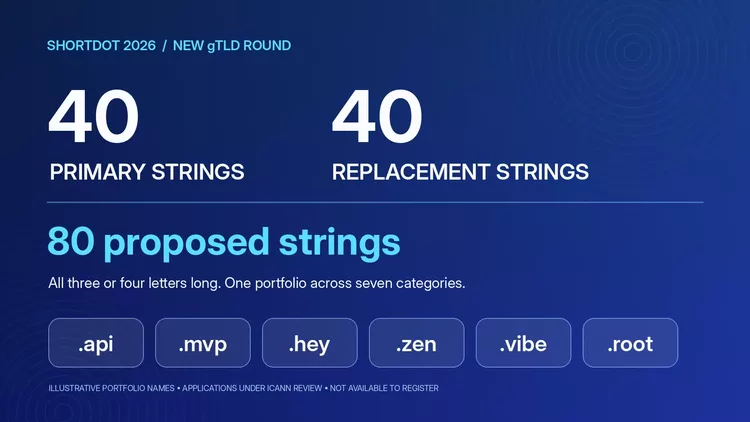
Now, ShortDot (Ireland) Limited has submitted 40 applications covering 80 proposed strings: 40 primary applied-for extensions and 40 designated replacement strings. Every one is just three or four letters long.
Think .api, .mvp, .hey, .fam, .zen, .vibe and .root. Some speak directly to technology or business. Others sound like something you'd say to a friend. The names span seven categories, but the thinking behind them is consistent: make them easy to remember, easy to understand and flexible enough for people to make their own.
You can explore the full ShortDot 80 portfolio and see the applications published by ICANN following Reveal Day on 7 October 2026. These are proposed extensions, not domains available to register today.
Which names stand out? We asked ShortDot
We caught up with Leroy Dsa, Head of Global Sales at ShortDot, to talk about what makes a good extension, the names he keeps coming back to and why short names might have particular appeal in Europe.
You've spent years speaking with registrars. Did those conversations influence which names made the list?
Leroy: Definitely. You quickly learn that a strong extension needs to make sense without a lengthy explanation. Names like .api, .hey and .mvp already carry meaning, so people can immediately start imagining what they could build with them.
Of all 80 proposed names, which is your personal favourite?
Leroy: I keep coming back to .hey. Maybe that's the salesperson in me, but almost every relationship starts with a hello. It feels human, welcoming and very easy to remember.
Any others you'd especially like to see out in the world?
Leroy:.mvp. Three letters, but they already mean something in startups, business, gaming and sport. I like names that can belong to very different communities without feeling forced.
Europe is a multilingual market. Does that change what makes a good extension?
Leroy: Absolutely. Europe is multilingual and businesses regularly operate across borders, so names that are short and easy to understand can travel well.
It's an interesting point. According to Eurostat's 2025 data, 79% of EU enterprises had a website, while 29.5% had website content in at least two languages.
Leroy: For me, names such as .see, .way, .crew, .zen and .api are interesting in that context because they're concise and leave plenty of room for different businesses and communities to make them their own.
Was the three- or four-letter limit the hardest part?
Leroy: Short was really just the starting point. A three-letter string still has to mean something and give people room to build around it. .root, .fam and .zen are good examples because each one can take you in several directions.
What are you looking forward to now that the applications are in?
Leroy: Hearing what other people see in the names. We've discussed them internally for a long time, but it becomes much more interesting when registrars, businesses and creators start telling us what they would build with them.
Short names, plenty of room to grow
Take .agi, .api and .mcp: compact names with obvious connections to technology. Then there's .hey, .why and .yes, which feel more like the language of everyday conversation. Names such as .glow, .mood, .vibe and .fam could take on entirely different meanings depending on the people using them.
That's what makes the portfolio interesting. It's not just about squeezing an idea into three or four letters. It's about choosing a word that leaves space for whatever comes next.
Of course, an application is only the beginning. ICANN's review process still determines which strings can move forward, and there's no confirmed date when domains under any successful new extension might become available.
In the meantime, have a name in mind for your next idea? Explore domain extensions already available at EuroDNS.
Application status note: ShortDot's portfolio comprises 40 primary applied-for strings and 40 designated replacement strings across 40 applications, not 80 separate applications. A replacement string is an alternative within an existing application; not every proposed string will proceed. ICANN published application information on 7 October 2026, and individual application and replacement statuses may change as the program progresses. The proposed extensions discussed here are not currently available for domain registration or reservation through ShortDot. All applications remain subject to applicable ICANN evaluation, objection, contention, contracting and delegation processes. Check ICANN's application records for current published information.
How to Set Up Shared Accesses in Your Account
Related articles: