Introducing Sectigo ACME SSL Automation Subscription

What if your SSL certificates could renew themselves automatically? No reminders, no downtime risks, no last-minute panic. That is exactly what ACME SSL subscriptions deliver. We are excited to launch a new way to manage website security: one that removes manual work and keeps your domains protected around the clock.
Introducing Sectigo ACME SSL Automation Subscription
SSL management is changing fast. For years, certificates were simple: buy one, install it, set a reminder, renew it later. That worked when you had one website with a long lifespan certificate. It starts to break when you have ten. Or fifty. Or infrastructure that keeps growing. And now, with certificate lifetimes shrinking, that old way of working is under real pressure.
This is exactly why we’re introducing the Sectigo ACME SSL Automation Subscription. Now, you have an reliable way to automate certificate management completely and remove the manual work behind it.
The Automated Certificate Management Environment (ACME) protocol automates certificate lifecycle management between Certificate Authorities (CAs) and systems such as web servers, email platforms, and connected devices. It removes manual steps and requires minimal configuration to operate at scale.
The problem with traditional SSL certificates
For years, SSL certificates have required manual management. You purchase a certificate, install it, track the expiration date, and repeat the process again when renewal time arrives.This works when you manage a single website. But once you have multiple domains, client projects, or growing infrastructure, the process becomes difficult to maintain. Deadlines get missed. Renewals get delayed. And when a certificate expires, websites can suddenly show security warnings or stop working entirely.
The real issue is not the certificate itself. It is the manual work around it.
Shorter certificate lifetimes are here
The industry has been steadily reducing SSL certificate validity periods. What used to last years now lasts months and that trend is continuing.
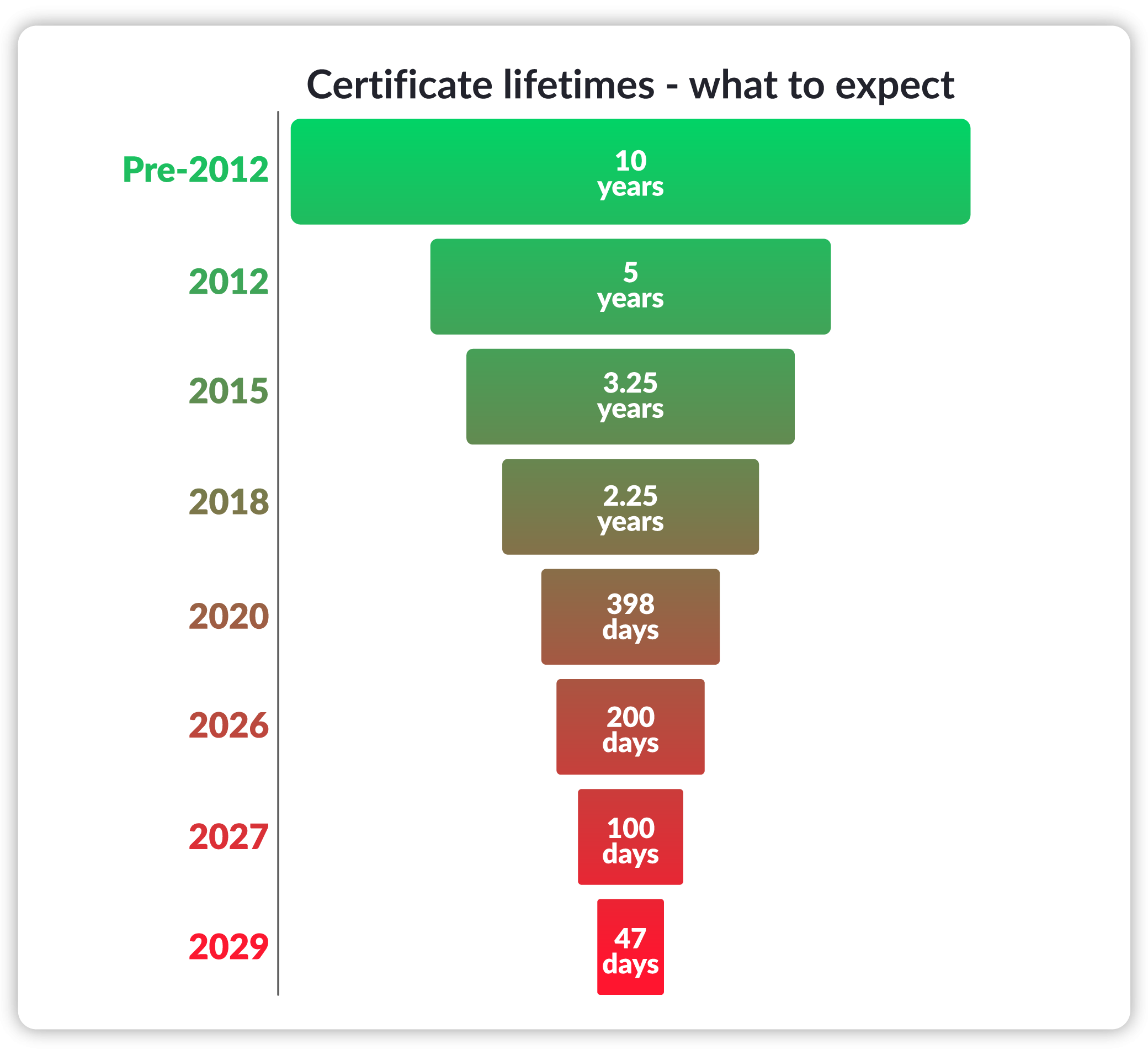
From a security perspective, this is a good thing. Shorter lifetimes reduce risk and improve trust across the internet.
Operationally, though, it creates more pressure:
- More renewals to manage
- More chances for human error
- More time spent on repetitive admin work
For teams managing multiple domains, manual renewal quickly becomes unsustainable. This is where automation stops being optional.
What is ACME and why it matters
ACME (Automated Certificate Management Environment) is a protocol that allows systems to communicate directly with a Certificate Authority like Sectigo.
Instead of logging into dashboards, generating CSRs, validating emails, and tracking expiry dates, everything happens automatically in the background.
Certificates are issued, validated, renewed, and replaced without manual intervention. In practical terms, SSL stops being something you actively manage. It becomes part of your infrastructure that simply works.
Traditional vs ACME-based certificate management
The difference is not just speed. It’s how much you need to think about it.
Feature | Traditional SSL | ACME-based SSL |
|---|---|---|
Workflow | Manual (forms, emails) | Fully automated (After initial set-up) |
Validation | Email-based | HTTP/DNS challenges |
Speed | Minutes to days | Seconds |
Expiry risk | High (human error) | Extremely low (auto-renewal) |
CSR generation | Manual | Automated |
ACME removes the human bottleneck — and with it, most of the risk.
What makes ACME SSL different?
ACME SSL works as a subscription-based automation service. You choose how many domains you want to secure, configure it once, and automation takes care of the rest.
Certificates are issued, installed, and renewed automatically before they expire. No reminders. No last-minute fixes. No downtime surprises. Just continuous protection running quietly in the background.
Real benefits you will notice immediately
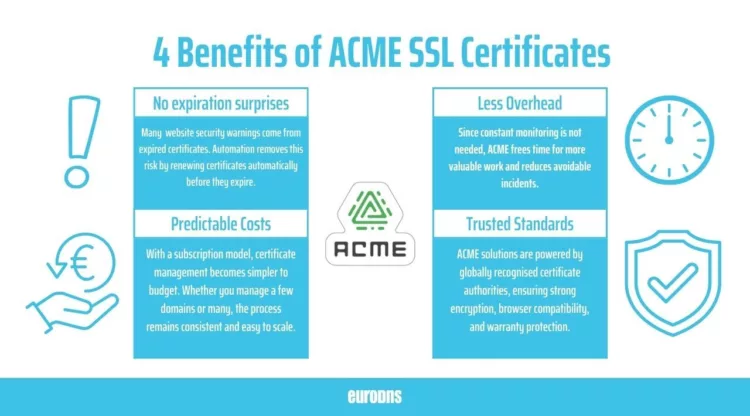
No more expiration surprises
Automation renews certificates before they expire, removing one of the most common causes of website security warnings.
Frees up time for your core business
No more tracking dates, repeating installations, or chasing renewals across environments. Your team gets that time back.
Predictable, scalable costs
The subscription model makes budgeting simpler and scales naturally as your infrastructure grows.
Trusted security standards
Backed by Sectigo, you get strong encryption, global browser trust, and warranty coverage suitable for business use.
Who benefits most from ACME SSL?
ACME is not a fit for everyone: this solution is best suited for organizations with dedicated IT resources, with control over their infrastructure and the ability to implement automation across environments. The initial ACME set up is not straighforward and is not recommended for single website owners or small teams.
Any organisation with a large domain portfolio will benefit from covering them with an ACME SSL Subscription. Some ideal use cases could be:
Growing businesses
As your digital footprint expands, automation keeps security aligned without adding workload.
Agencies and freelancers
Managing multiple client sites becomes simpler, with fewer recurring tasks and fewer emergencies.
Hosting providers and SaaS platforms
Automated certificate provisioning scales cleanly with dynamic environments.
Developers and IT teams
ACME integrates naturally into DevOps workflows, CI/CD pipelines, and infrastructure automation.
A simple way to think about it
Traditional SSL is like renewing a subscription manually every time.ACME SSL is like auto-renewal that happens before you even notice it’s needed.
The security stays the same. The effort drops dramatically.
When this may not be the right fit
As powerful as ACME automation is, it’s not always the right tool for every setup.
If your environment is relatively simple, full automation can feel like overkill. ACME is designed for scale and repeatability — so if you don’t have that complexity, you may not get the full value from it.
If any of these apply to you, ACME may not be right for you:
- Shared hosting environments where SSL is already managed for you
- No access to server or DNS configuration (required for ACME validation)
- A small number of domains that are easy to track manually
- No existing DevOps or automation workflows in place
- Preference for a simple, one-time setup without additional configuration
In these cases, a traditional SSL certificate is often the more practical option. You can install it once, manage it manually, and avoid the need to set up automation workflows.
Solutions such as Sectigo InstantSSL or Sectigo DV SSL are designed for simplicity, making them a better fit for smaller projects or less complex environments.
A good way to think about it: if you’re managing just a few websites and everything is under control, traditional SSL works perfectly well. But as soon as things start to scale, that’s where ACME begins to make a real difference.
Ready to stop thinking about SSL?
That’s the real benefit here. Not better certificate management. Not faster renewals. With the Sectigo ACME SSL Automation Subscription, you configure it once and let automation handle the rest.
Get a Free Domain with Hosting: Introducing Bundles
Related articles: