13 Best Domain Extensions for Tech Companies in 2026

Are you starting a tech company or coming up with new tech ideas? Choosing the right domain name is a big deal - it needs to be sharp, memorable, and make a statement. Then why not choose a domain that attracts visitors as excited about technology as you are?
A strong technology brand needs a domain name that is clear, memorable and easy to share. But finding the right .COM can be difficult—especially when your company name uses a common word or your preferred address is already registered.
The good news is that tech businesses have plenty of credible alternatives. Extensions such as .TECH, .AI, .APP, .DEV and .CLOUD can immediately communicate what your company builds or who it serves. The right choice can also give you a shorter, more distinctive address without forcing an awkward variation of your brand name.
Below, we compare 13 of the best domain extensions for technology companies in 2026, including their strengths, limitations and ideal use cases.
Best tech domain extensions at a glance
Extension | Best for | Main advantage | Consider before choosing | Register |
|---|---|---|---|---|
.TECH | Technology companies of almost any kind | Short, relevant and easy to understand | Popular names may already be registered | |
.AI | Artificial intelligence and machine-learning brands | Instantly communicates an AI focus | Often costs more than mainstream extensions | |
.APP | Mobile apps, web apps and SaaS products | Clear product positioning and HTTPS required | An SSL certificate must be configured before launch | |
.DEV | Developers, portfolios, documentation and tools | Strong developer identity and HTTPS required | May feel too technical for a general audience | |
.IO | Startups, APIs and developer-focused products | Short and widely recognised in technology | It is a country-code domain with a changing geopolitical context | |
.CLOUD | Cloud platforms, storage and SaaS providers | Clearly describes cloud-based services | Less suitable if the business later expands beyond cloud products | |
.SOFTWARE | Software developers and vendors | Highly descriptive | Longer to type and say aloud | |
.TECHNOLOGY | Consultancies and innovation-led businesses | Descriptive with potentially broader name availability | Considerably longer than .TECH | |
.HOST | Hosting, infrastructure and server providers | Immediately explains the service | Narrow positioning for companies with wider ambitions | |
.NETWORK | Networking, telecoms and online communities | Works for both infrastructure and people-focused platforms | The meaning can be broad | |
.COMPUTER | Hardware, repairs and IT services | Direct and easily understood | Can sound hardware-specific | |
.SOLUTIONS | IT consultancies and B2B service providers | Flexible, service-oriented positioning | Less distinctive without a strong brand name | |
.XYZ | Startups, creative technology and Web3 projects | Flexible and unconventional | Does not explain the business by itself |
How to choose a domain extension for your tech company
Your extension should support the brand rather than carry the whole brand on its own. Before registering, consider these five questions:
- Is it immediately understandable? Someone hearing the domain once should be able to type it correctly.
- Does it fit your long-term direction? A very specific extension can be powerful, but it may become restrictive if the company expands.
- Will customers trust it? Familiarity varies by audience. Developers may recognise .IO or .DEV instantly, while mainstream buyers may need more context.
- What will it cost over time? Compare renewal and transfer prices as well as the introductory registration price.
- Could it conflict with another brand? A domain being available does not mean you have the legal right to use the name. Check relevant trademark databases before building your identity around it.
If your budget allows, consider registering the most obvious variations and redirecting them to your primary address. This can help protect the brand and prevent visitors from landing on the wrong website.
1. .TECH
.TECH is the most versatile extension on this list. It works for startups, established technology firms, hardware manufacturers, software products, consultancies and research projects. It is short enough to remember and specific enough to tell visitors what sector you operate in.
It is particularly useful when your preferred .COM is unavailable but your exact brand name remains available under .TECH.
Example: Planys.tech uses the extension for a company specialising in underwater robotic inspection technology.

2. .AI
.AI is the country-code extension for Anguilla, but it has become a globally recognised address for artificial-intelligence businesses. Google currently treats .AI as a generic country-code extension for search purposes rather than assuming every .AI site targets Anguilla.
It is a natural choice for generative-AI products, automation tools, machine-learning platforms and data companies. However, a .AI address does not make a product genuinely intelligent or trustworthy. Your brand, product and evidence still need to support the claim.
Example: Viggle.ai uses artificial intelligence to animate characters and turn static images into video content.

3. .APP
.APP is designed for mobile applications, browser-based tools, games and software-as-a-service products. The extension is concise and gives visitors a strong indication that they are about to visit a product rather than a general company website.
The entire .APP extension appears on the HSTS preload list, so browsers require an encrypted HTTPS connection. That is a useful security feature, but it also means you must configure a valid SSL certificate before the website will work correctly.
Example: Cash.app uses the extension as a short, memorable address that matches its product name.
4. .DEV
.DEV is a strong choice for developer portfolios, technical documentation, APIs, open-source projects and software tools. Like .APP, the extension is HSTS-preloaded and requires HTTPS on every connection.
The main question is audience. A .DEV address feels immediately relevant to engineers, but a consumer-facing product may benefit from a broader extension.
Example: Web.dev is Google's educational platform for modern web-development guidance.
5. .IO
.IO is popular among startups because “I/O” means input/output in computing. It is short, familiar to technical audiences and treated by Google as generic for search targeting.
However, .IO is technically the country-code extension for the British Indian Ocean Territory. The UK's agreement to transfer sovereignty over the Chagos Archipelago to Mauritius has created uncertainty about the territory's future ISO country code—and therefore the long-term status of .IO.
This does not mean .IO is about to disappear. Under IANA's ccTLD retirement process, retirement would only begin if the underlying code became ineligible and IANA issued a formal notice. The default transition period would then be five years, with a possible extension of up to five more. No business should treat a future outcome as settled before that process occurs.
For a new long-term brand, weigh this uncertainty against .IO's strong recognition in the technology sector. Existing owners should keep their registration and contact details current and maintain a contingency plan rather than panic or migrate based on speculation.
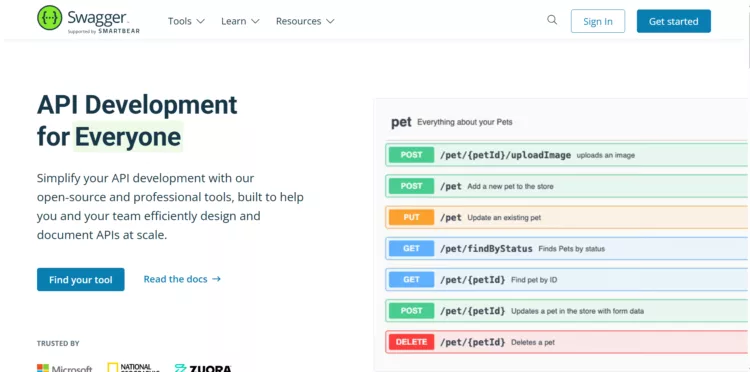
Example: Swagger.io uses the extension for its suite of API development tools.
6. .CLOUD
.CLOUD suits hosting platforms, online storage, infrastructure services, cloud consultancies and SaaS products. It gives immediate context and can work well for a dedicated customer portal or service status page as well as a primary website.
Consider whether “cloud” will still describe the business in five years. If you expect to expand into hardware, consulting or other services, a broader extension may give the brand more room to grow.
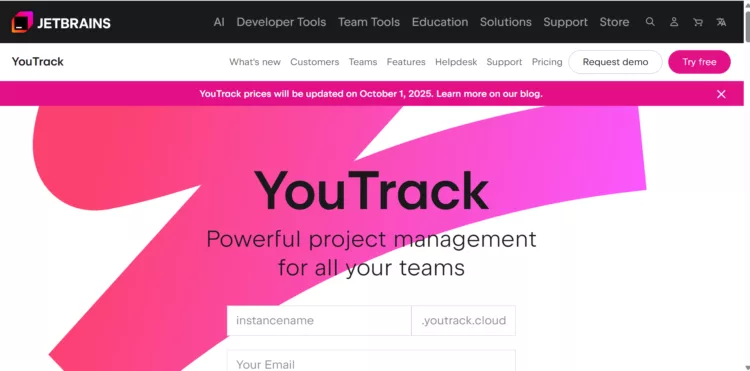
Example: YouTrack.cloud is used for cloud-hosted instances of JetBrains' project-management platform.
7. .SOFTWARE
.SOFTWARE removes any ambiguity about what your business provides. It can be effective for development studios, enterprise-software vendors and independent products, particularly when a short brand name comes before the dot.
Its main disadvantage is length. Test the complete domain in email addresses and say it aloud before registering it.
Example: Cubix.software uses the extension to reinforce its focus on business and financial-management software.
8. .TECHNOLOGY
.TECHNOLOGY offers the clarity of .TECH in a longer, more formal format. It can work particularly well for consultancies, engineering companies and corporate innovation programmes.
Because the extension is long, pair it with a short name. Avoid combinations that become difficult to type, fit into marketing materials or communicate verbally.
Example: Sinara.technology uses the extension for a software-engineering and technology consultancy.
9. .HOST
.HOST is one of the clearest choices for web-hosting companies, infrastructure platforms, data-centre services and managed-hosting providers. It tells potential customers what the company offers before they visit the site.
That precision is also its limitation. A company planning to move beyond hosting may prefer a more flexible primary domain and use .HOST for a specific product or campaign.
10. .NETWORK
.NETWORK can represent physical infrastructure, telecommunications, cybersecurity, professional communities or social platforms. This flexibility makes it useful for organisations connecting either systems or people.
Example: A cybersecurity consultancy could use a name such as secure.network, while a professional community could build its identity around members.network.
11. .COMPUTER
.COMPUTER is a direct option for PC retailers, repair services, hardware manufacturers, gaming specialists and IT-support companies. It is less fashionable than .AI or .TECH, but its meaning is obvious to a wide audience.
It is best suited to businesses whose offer will remain closely connected to computers or hardware rather than broader digital services.
12. .SOLUTIONS
.SOLUTIONS works well for IT consultancies, systems integrators, support businesses and B2B service providers. It communicates a problem-solving offer without locking the company into one technology.
Because “solutions” is widely used in business names, the word before the dot needs to be distinctive enough to make the complete address memorable.
13. .XYZ
.XYZ is deliberately broad. It is popular with startups, creative technology projects and digital communities that want a modern identity without describing one product category.
Alphabet's use of abc.xyz remains the best-known example: the company combined its name and extension to complete the alphabet. This demonstrates the branding potential of a TLD when both sides of the dot work together.

Do tech domain extensions affect SEO?
Choosing .TECH, .AI or another new extension does not automatically improve your search rankings. Google generally treats generic top-level domains equally, while some country-code extensions can act as a geographic signal.
Google currently treats both .AI and .IO as generic for search targeting. Your content quality, technical performance, links, brand recognition and user experience will matter far more than the extension alone.
A relevant extension can still help indirectly. A clear, memorable domain may improve recognition and make it easier for customers to understand and share your address.
Frequently asked questions about tech domains
What is the best domain extension for a technology company?
.TECH is the strongest all-purpose option because it is short, clear and flexible. More specialised businesses may prefer .AI, .APP, .DEV, .CLOUD or .SOFTWARE.
What is the best domain for an AI startup?
.AI provides the clearest category signal for an artificial-intelligence company. Before registering, compare the total renewal cost and check that the complete name does not infringe an existing trademark.
Should I choose .TECH or .TECHNOLOGY?
.TECH is shorter and easier to say, while .TECHNOLOGY is more descriptive and may offer different naming opportunities. In most cases, .TECH is the more convenient primary address.
Why do .APP and .DEV require HTTPS?
Both extensions are included on the HSTS preload list. Compatible browsers will only connect to these domains securely over HTTPS, so the website needs a valid SSL certificate from the beginning.
Is it safe to register a .IO domain in 2026?
.IO remains available and operational. However, its long-term status is connected to the ISO country code for the British Indian Ocean Territory. New registrants should understand that uncertainty and avoid treating speculation about either guaranteed survival or imminent deletion as fact.
Can I register more than one extension?
Yes. Registering relevant alternatives can help protect your brand. Choose one primary address and redirect the others to it so customers and search engines see a consistent website.
Find the right domain for your technology brand
The best tech domain is not necessarily the trendiest extension. It is the name that fits your product, remains useful as the company grows and feels credible to the audience you want to reach.
Once you have a shortlist, compare availability, renewal prices and registration requirements before deciding. Then register early—strong, concise technology names rarely remain available forever.
What is Domain Privacy? Why is it Important?
Related articles: