20 Years of .EU: An Interview With Xavier Buck
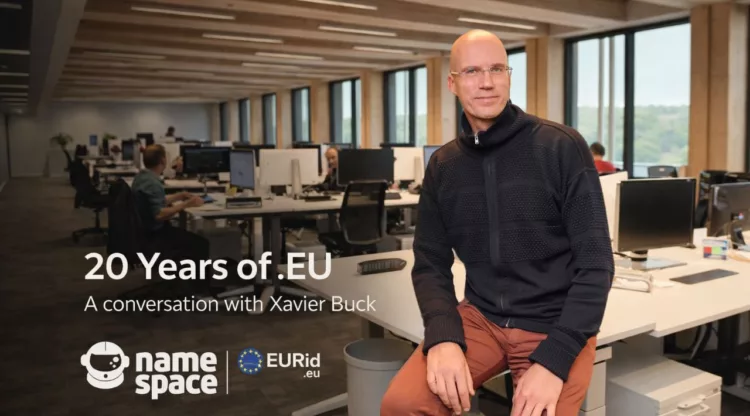
The launch of .eu wasn’t just another domain drop: it was Europe claiming its place online. In this exclusive Q&A, our founder breaks down the ambition and lessons from that time, and highlights which of those forces still shapes the domain industry today.
In a few days, .EU will turn 20 years old. Looking back through the lens of today's bustling domain landscape, it's hard to describe the impact this TLD's launch had on Europe and beyond.
When .eu launched, it did more than introduce a new web address. It marked the arrival of a shared European digital space that carried commercial ambition, the ideals of a pan-european identity, and a new way for individuals and organizations to present themselves online.
We sat down with our founder to reflect on that moment, the complexity behind the launch, and what the rise of AI means for the future of domains.
“.eu gave Europe a shared digital identity and showed that a domain extension could carry real political, commercial, and symbolic value.”
What made the launch of .eu such an important moment?
The launch of .eu was important because, for the first time, it created a truly European domain space. It was not just another extension, it was seen as the European domain, almost like the crown on top of the cake.
For many businesses and brand owners, having a .eu name meant having a clear European identity online. At that time, domain registration was still quite complex, so launching a platform that could handle registrations across Europe was a major step.
What was the biggest challenge during that period?
The biggest challenge was managing the complexity of the launch itself. There were different phases such as Sunrise, Landrush, premium domains, and strong demand from customers who all wanted the best names.
The registration process involved a lot of technical and operational difficulty, and we had to build a platform that could guide customers through multiple levels, different periods, and constantly changing rules. Delivering a good customer experience in that environment was not easy.
Launch timeline
- 7 December 2005: Sunrise phase began
- April 2006: Public registration opened
Source: European Commission / CORDIS
What did that experience teach you about the domain industry?
It taught me that the domain industry is never just about technology, it is also about timing, trust, regulation, and customer experience.
A successful launch depends on much more than simply making names available. You need reliable systems, clear communication, and the ability to adapt quickly when demand is high and the rules are evolving.
Do you see any parallels or contrasts between that time and where we are today?
There are some parallels, but also big contrasts. Back then, everyone was waiting for one new extension that had huge symbolic value.
Today, there are many possible extensions, so attention is spread much more widely. That makes the environment very different. What is interesting today is the pace of change, especially with AI coming into the picture.
AI is already influencing website creation, programming, and domain-related services, so the challenge now is staying relevant and continuing to offer customers the right tools at the right time.
Top 10 countries for .eu registrations
Rank | Country | Domain names |
|---|---|---|
1 | Germany | 966,533 |
2 | Netherlands | 440,795 |
3 | France | 318,414 |
4 | Poland | 265,365 |
5 | Italy | 263,687 |
6 | Portugal | 166,720 |
7 | Belgium | 146,213 |
8 | Spain | 143,517 |
9 | Czechia | 184,095 |
10 | Austria | 114,680 |
Source: EURid statistics
If you had to summarise the impact of .eu in one sentence, what would it be?
.eu gave Europe a shared digital identity and showed that a domain extension could carry real political, commercial, and symbolic value.
What did most people get wrong about .eu at the time?
Many people underestimated how complex and significant the launch would be. Some saw it as just another extension, when in fact it was a major European project with high expectations, strong competition for premium names, and a lot of operational and technical challenges behind the scenes.
Two decades on, .eu remains more than a domain extension. It is still a marker of European presence online and a reminder that digital identity is shaped as much by trust, timing, and vision as it is by technology.
.hamburg domain: your digital home for locals
New Payment Provider: Stripe
Related articles: