Why shorter domain names win: clarity, recall, and real marketing impact

In a space where attention is limited and competition is endless, the difference between a long, descriptive domain and a short, brandable one shows up in clicks, recall, and trust. The brands that understand this do not treat brevity as a preference. They treat it as an advantage.
Short domain names look better, and they perform better too.
In a space where attention is limited and competition is endless, the difference between a long, descriptive domain and a short, brandable one shows up in clicks, recall, and trust. The brands that understand this do not treat brevity as a preference. They treat it as an advantage.
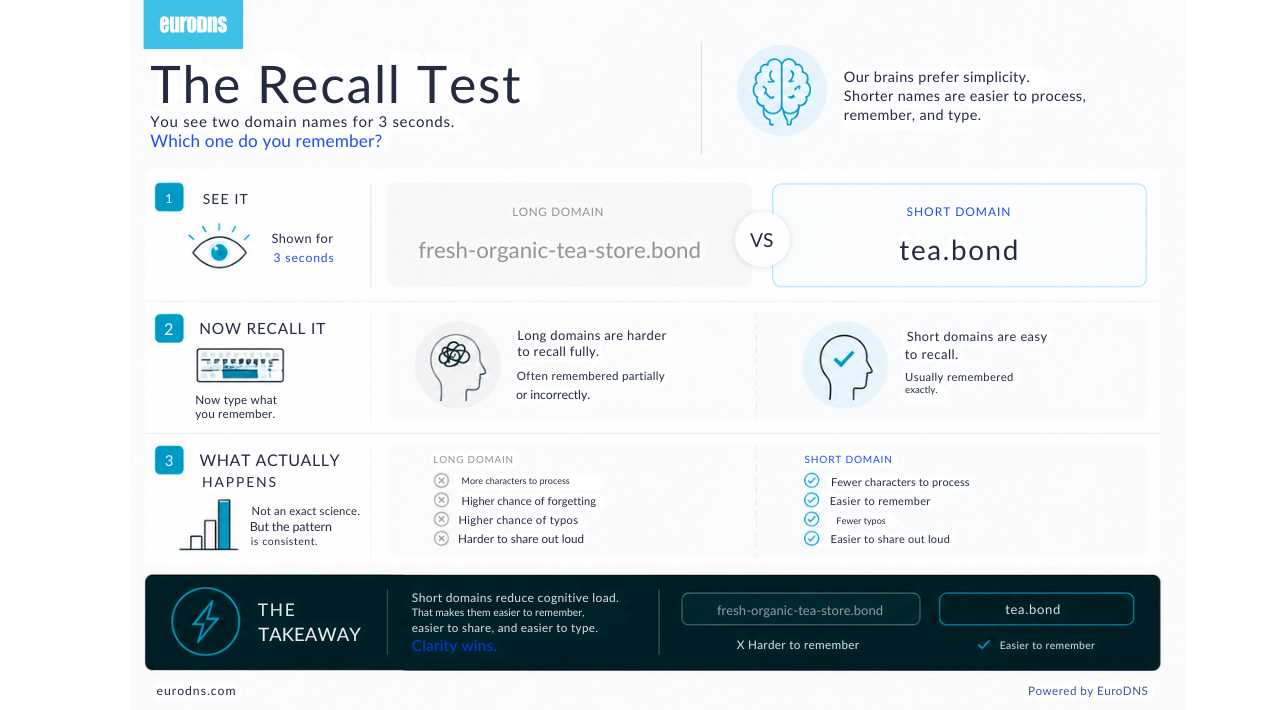
Short names are easier to remember
People do not remember URLs the way they used to. They scan, skim, and move on. If your name does not stick instantly, it is gone.
Compare this:
- fresh-organic-tea-store.net
- tea.icu
One tries to explain everything. The other is self-explanatory.
Short names reduce cognitive load. There is less to process, fewer chances to forget, and a much higher chance someone recalls the name later without needing to search again.
That matters more than ever because a lot of traffic is not immediate. It is delayed. Someone hears your name, thinks about it later, and tries to find you. If they cannot remember it, you have lost them.
Case study: X.com and the power of simplicity
When Twitter rebranded to X, it was not just a visual shift. The move to x.com turned the brand into one of the shortest digital identities possible.
The result is extreme recall. One letter. Almost impossible to mistype. Instantly recognizable.
Whether people agree with the rebrand or not, the domain itself proves a point. Short domains remove friction completely. There is nothing to decode.
Short domains improve word-of-mouth
A big part of growth still comes from people talking.
“Check out this site…”
“Have you seen this brand…”
Now imagine saying:
- fresh-organic-tea-store.net
- tea.icu
One feels awkward to say out loud. The other flows naturally.
If your domain does not sound good when spoken, it will not spread easily. Short names are conversational. That makes them shareable.
And shareability lowers your marketing cost. You do not have to rely only on ads if your audience can pass your name around effortlessly.
They look better everywhere
Short domains do not just sound better. They look better across every channel.
Think about where your domain appears:
- Instagram bios
- Email signatures
- Ads
- Billboards
- Packaging
A long domain wraps, breaks, or gets truncated. A short one stays clean and sharp.
This matters in high-visibility placements. On a billboard or a reel, you do not get time to explain. You get a second. Maybe two.
A name like greenglow.icu is readable at a glance. No clutter, no confusion.
Case study: Ring.com and the cost of being long
Before becoming Ring, the company was called Doorbot. Functional, but not memorable.
The shift to a shorter name and the acquisition of Ring.com made the brand easier to recall, easier to trust, and easier to scale.
Founder Jamie Siminoff has spoken about how much value the domain added during growth.
Shorter name. Cleaner identity. Stronger brand.
That is not coincidence. That is strategy.
Short domains build stronger brands
Long domains tend to describe. Short domains tend to represent.
There is a difference.
- buybestorganicteaonline.store
- tea.icu
Descriptive names can help early on, especially for search intent. But they rarely build emotional connection.
Short names leave room for meaning. They let the brand grow beyond the category.
Think about brands like:
- Uber
- Nike
- Zara
None of them explain what they do in the name. They own it instead.
A short domain works the same way. It becomes a container for your brand, not a sentence about it.

Fewer errors, less lost traffic
Every extra character in a domain increases the chance of mistakes.
- Misspellings
- Wrong hyphen placement
- Forgetting a word
All of these lead to lost traffic.
Short domains reduce that risk. They are harder to mess up and easier to type correctly on the first try.
This is especially important on mobile, where typing accuracy drops and patience is even lower.
Better fit for modern marketing
Marketing today is fast, visual, and mobile-first.
You are not just placing a domain on a website. You are putting it in:
- Reels
- Stories
- Ads
- QR code overlays
Short domains fit this environment perfectly.
They:
- Load quickly in the brain
- Do not compete with visuals
- Stay readable even in motion
A long domain demands attention. A short one earns it instantly.
The role of new extensions
One reason short domains were hard to get was availability.
Most short .com names are already taken. That forced brands into longer, compromised versions.
New extensions change that.
They open up space for:
- Clean, one-word names
- Meaningful combinations
- Brandable identities
For example:
- care.icu
- focus.icu
- connect.bond
These are not just shorter. They are clearer.
The extension itself adds context, so you do not need extra words in the name.
Short domains scale better
What works for a small project often breaks at scale.
A long, niche domain might work early on, but it becomes limiting as the brand grows.
Short domains are flexible. They do not lock you into one product, one category, or one message.
That makes expansion easier.
You do not have to rebrand when you evolve. The name already has room to grow.
Common mistakes to avoid
Even when aiming for shorter domains, brands often get it wrong.
1. Cutting length but losing clarity
Short does not mean cryptic. If people cannot understand it, it will not work.
2. Using awkward abbreviations
If it feels forced, it will not stick.
3. Ignoring pronunciation
If people cannot say it, they will not share it.
The goal is simple, not confusing.
Final thought
Short domains work because they respect how people think and behave online.
They are easier to remember, easier to share, and easier to trust.
In a world where attention is expensive, that simplicity becomes a competitive edge.
Not every brand can own a single-word name. But every brand can aim for clarity, brevity, and ease.
And the closer you get to that, the stronger your brand becomes.
The .ART Award: where creativity meets the digital world
Related articles: