How AI and Search Engines Interpret Domain Names in 2026

Search engines and AI-driven discovery systems no longer evaluate websites the way they did a decade ago. While a domain name alone will not make a website rank, it increasingly influences how systems interpret intent, credibility, and relevance
Lately, one sentence has dominated conversations about domains and SEO:
“Domain names don’t matter for search engines.”
In 2026, that statement is practically misleading.
Search engines and AI-driven discovery systems no longer evaluate websites the way they did a decade ago. While a domain name alone will not make a website rank, it increasingly influences how systems interpret intent, credibility, and relevance, especially in environments where AI summarizes, recommends, and filters information before users ever click.
This article explains how modern search engines and AI systems interpret domain names today, what has changed, and what still matters if you are choosing a domain now.
The outdated myth: “Domains don’t matter”
The myth started from a narrow truth: search engines do not give ranking boosts simply because a domain contains keywords.
That is still correct.
What has changed is how many decisions happen before ranking even becomes relevant. In 2026, domain names influence:
- How systems classify a site (informational, commercial, brand, niche, etc.).
- How AI systems summarize and select sources for answers.
- How users decide whether to trust and click.
- How platforms estimate legitimacy vs. disposable or low-quality content.
Domains do not directly determine rankings but they shape interpretation, and interpretation affects everything downstream.
How search engines evaluate domains in 2026
Search engines behave like classification systems first and ranking systems second.
Before content quality is assessed, systems try to answer questions such as:
- Is this site likely to satisfy the user’s intent?
- Is it tied to a real entity or brand?
- Does it appear stable over time?
- Are there signs it may be deceptive, misleading, or low trust?
A domain name contributes weak but consistent signals to these judgments. For example:
- A clean, readable domain supports intent clarity.
- A domain aligned with a sector or geography can improve contextual understanding.
- A domain that looks spammy, misleading, or disposable can increase skepticism thresholds.
None of this guarantees success, but poor signals add friction especially for new sites with limited history.
How AI systems interpret domain names
AI-driven discovery systems do not “read” a domain name like a human does. They rarely treat keywords as literal instructions. Instead, they infer meaning through patterns, associations, and consistency.
In practice, systems look for coherence between:
- The domain name and the site’s topic.
- The site’s claims and its observable signals (content quality, references, structure).
- The site’s identity over time (consistency of purpose, stability, continuity).
That is why a “clever” name is less important than a coherent identity. AI systems reward clarity and consistency, not naming tricks.
Do domain extensions matter?
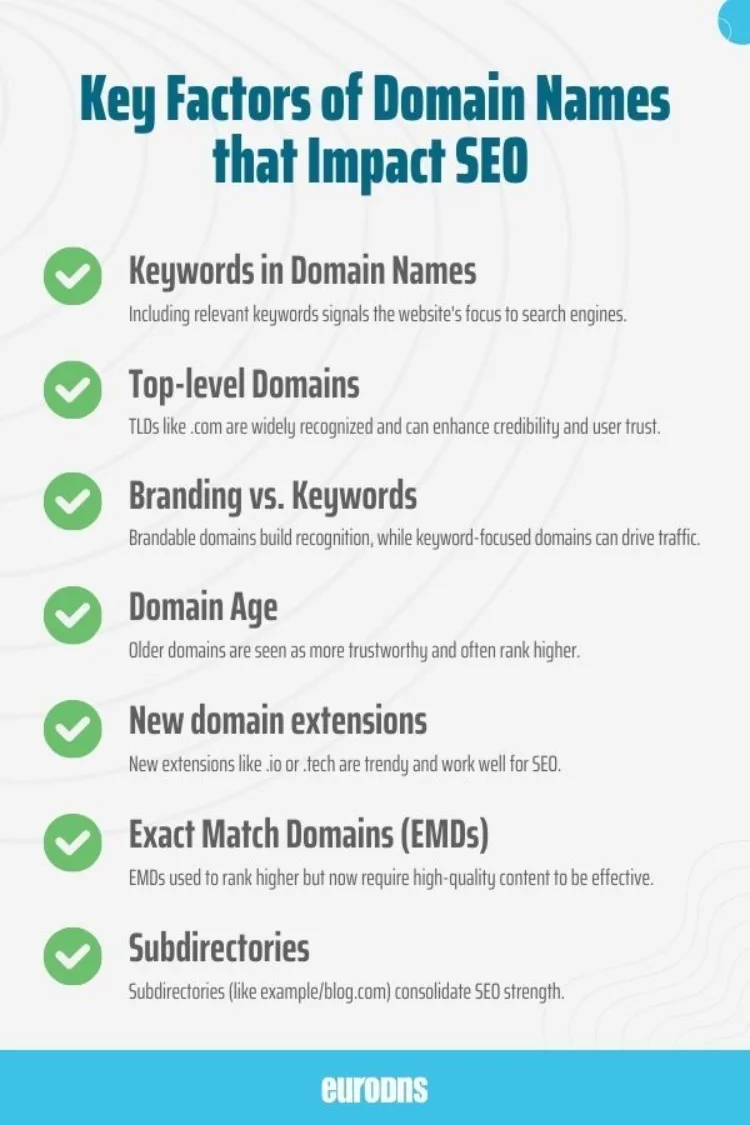
Domain extensions (TLDs) still do not provide an inherent SEO advantage. However, they often influence human interpretation—and indirectly, how systems model trust and intent.
In real-world behavior, certain extensions are commonly associated with:
- Industry relevance (e.g., finance, tech, education, healthcare projects often choose extensions that match their niche).
- Geographic scope (e.g., country-code domains can signal a regional audience).
- Experimentation (newer or novelty extensions may be used for campaigns or short-term projects).
AI systems typically combine signals such as:
- Domain and URL patterns.
- Content quality and topical consistency.
- User interaction signals (clicks, engagement, returns).
- Site history and stability.
The extension will not make you rank, but it can help systems—and people—quickly understand what your project is.
When domain choices actively hurt visibility
Most domain decisions are neutral. A few create real obstacles.
Common patterns that tend to increase friction for both users and automated systems include:
- Imitating brands or using confusing names that resemble established entities.
- Overly complex domains that users struggle to remember or type accurately.
- Misleading intent (domain implies one thing; content delivers another).
- Frequent domain changes that break continuity signals (links, mentions, recognition).
- Low-trust neighborhood risk (some domains accrue poor reputations due to heavy abuse—this does not “penalize” you automatically, but it can raise scrutiny).
This is not about algorithmic penalties. It is about confidence thresholds: the worse the signals, the more evidence a system needs before treating a site as reliable.
What matters more than the domain name
If domain names do not directly boost rankings, why do they still matter so much?
Because domains sit at the intersection of branding, trust, longevity, and technical stability.
In practice, these factors matter more than the name itself:
- Stable ownership and management (renewals, access control, and consistent administration).
- Consistency of purpose (the topic and promise stay aligned over time).
- Long-term continuity (the same identity builds recognition, links, and references).
- Clear information architecture (site structure that makes it easy to understand your topic).
In modern discovery systems, consistency beats cleverness.
How to choose a domain in 2026
If you are choosing a domain today, focus on fundamentals that reduce friction and increase trust:
- Choose a name that clearly reflects your project, brand, or audience.
- Prioritize readability and memorability over novelty.
- Avoid gimmicks that sacrifice clarity for short-term attention.
- Think long-term: a domain is infrastructure, not a campaign asset.
- Align your domain, content, and visitor expectations from day one.
A domain will not rank your site for you. But a poor domain choice can slow down everything you build on top of it.
The bottom line
Search engines and AI systems in 2026 do not reward domain hacks. They reward clarity, consistency, and credibility.
Your domain is not a shortcut—but it is a signal. And in a world where machines increasingly decide what gets shown first, signals compound.
FAQ
Does a keyword in my domain help SEO?
Not in a reliable, direct way. Modern systems do not reward keyword-stuffed domains. A clear name can help with user understanding and click behavior, but rankings come from content quality, relevance, and trust signals.
Is a .com always better?
No. A .com is familiar and widely trusted, but many projects succeed on other extensions. The best choice depends on brand fit, audience expectations, and long-term plans.
Can a “bad” domain prevent my site from ranking?
A domain rarely blocks rankings by itself, but confusing, misleading, or unstable domain choices can increase friction and reduce trust. That means your site may need more evidence—more quality content, more references, more consistency—to achieve the same results.
Do I need to buy multiple extensions?
Not always. It can make sense for brand protection in some cases, but most projects should start with one strong primary domain and focus on building a consistent identity.
Note: This article describes observed patterns in modern search and AI discovery. It does not provide ranking guarantees.
Create your own email domain: 2026 Guide
Related articles: